
A simple framework to define vision and roadmap
In my experience, I've observed a bit of friction between business and IT teams. At times, IT teams say that business requirements are unclear, keep changing daily, and lack a clear product vision or roadmap. On the other hand, business teams say that IT teams do not deliver products or features as agreed, and there are always delays.
I also observed that IT teams direct business teams to align requirements with technical capabilities and solutions that have already been procured. This elevates the friction because the business teams do not get everything they wanted, resulting in a compromise on product features.
I have noticed several consequences of this friction, including:
- A firm procured a CRM (SaaS) solution, aiming for a quick-to-market, low-code rollout, but the necessary heavy customization ultimately negated the expected cost savings and speed-to-value.
- A firm invested over a million dollars in procuring a data management solution, only to find no business units were willing to use or fund it, leading to the inevitable non-renewal of the contract.
If this resonates with your experience, please continue reading.
This brings a valuable question: How can we build a prioritized roadmap using a simple framework and get alignment across the board?
Let’s dive into it.
A week is sufficient to flesh out a roadmap for 1 to 3 years. A series of workshops is required as outlined below:
Product Vision
It’s vital to define the product vision to ensure that the team has a clear understanding of the product’s future. The vision could be internal facing or external facing. Not all companies make their vision public due to competition in the market and to retain a competitive advantage.
External facing
A product vision is a concise, future-oriented statement that describes the long-term benefits the product will create for its users or the world, grounded in an understanding of the product’s purpose, target customers, and the value it aims to deliver.
Examples of publicly available vision statements:
- Microsoft Windows – “To empower people and organizations through a unified, secure, and productive computing platform.”
- Meta VR headsets – “To help build the next computing platform and enable people to feel present, even when they’re apart.”
Internal facing
A product vision for an internal product describes the future state the organization aims to achieve through the product, and how it will make internal users’ work easier, faster, or more efficient and effective. The internal facing vision is not made public.
Mission
It is a concise statement of the product’s purpose, describing what it does today, for whom, and the value it delivers, aligned with the company’s broader strategic goals.
Example of publicly available vision statements:
- Android – “To bring the power of computing to everyone.”
Write goals and objectives – ~4 hours
- Divide the team into small groups (2-3 people in a group).
- Ask people to write one goal per sheet of flipchart. Then, they should break it down into objectives detailing the Business KPIs (both qualitative and quantitative), internal and external dependencies, risks, assumptions, and, most importantly, test data needs where applicable.
- The facilitator goes around the room, helping the team if the participants have any questions about the process, template etc.
- Don’t just write qualitative metrics here. Quantify the expected benefits e.g. instead of writing “Improved customer experience”, determine and quantify the increase in revenue, for example.
- Another area is regulatory requirements or street mandates, where people say the benefits or outcome can’t be quantified. Think about how much fine the company will need to pay if the regulatory requirements are NOT met. Think of reputational damage to the company due to consequences of not complying with regulatory requirements.
- This part of the workshop is to identify “business needs”; so, IT members shouldn’t be engaged actively, and the goals must be written by members of the business team. This will ensure that business needs are NOT driven by technical influence.
- I have often seen people neglect test data until the development cycle begins, at which point they scramble to get proper test data or end up not doing thorough testing by creating just a few records by themselves. This will lead to quality issues down the road and eventually lead to rework ($$$) very late in the lifecycle.
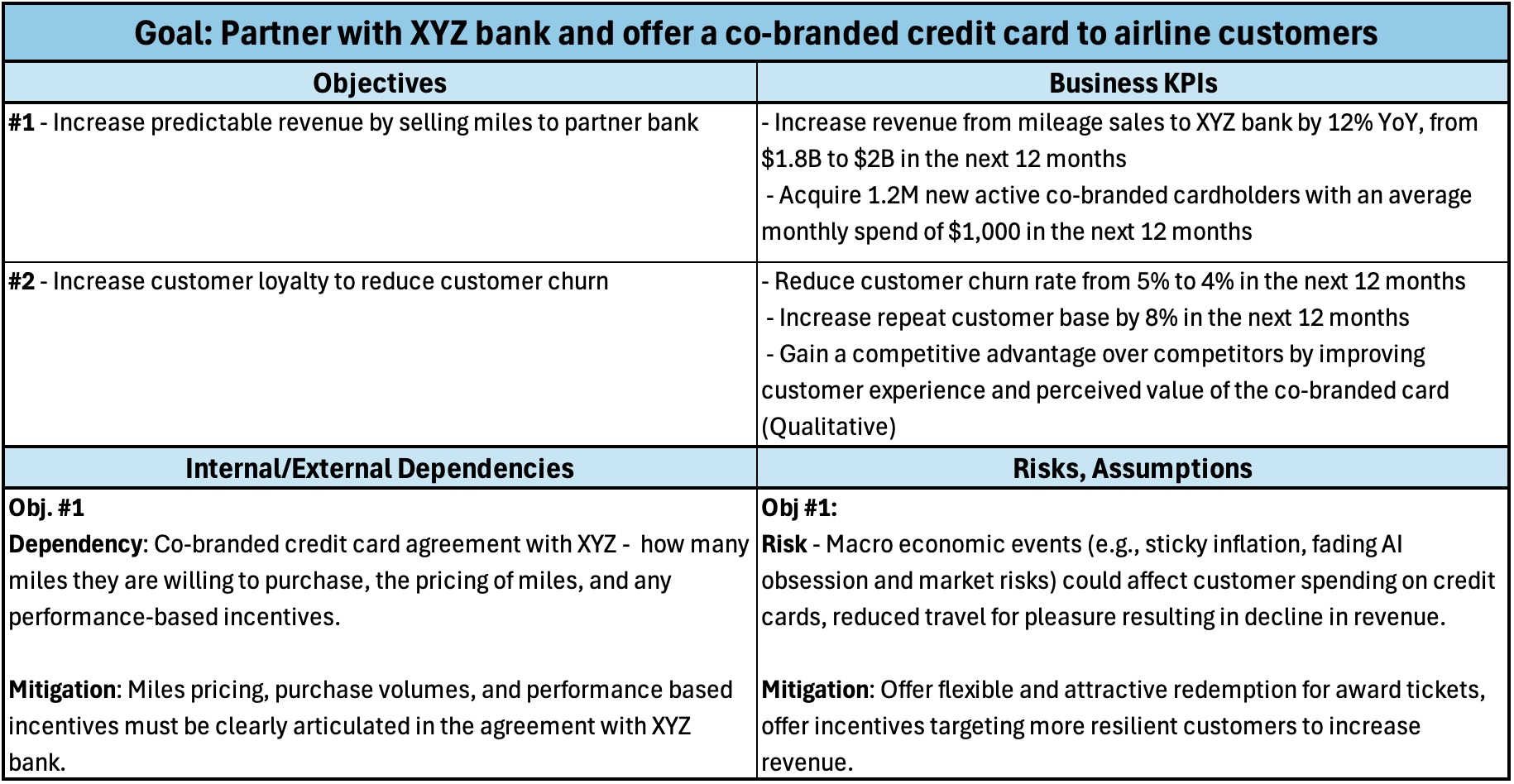
Pitfalls to avoid:
Review the goals, categorize, sort/merge them – ~2 to 4 hours
- The business team members go around the room, read the goals, and ask questions so that the original authors can clarify any points.
- Categorize the goals into different buckets and post or pin them on the wall so the goals for each group are visible.
- Sort/Merge the goals if there are synergies and/or duplicates.
Convert the final set of goals and related details into electronic format
- Convert the final set of goals into an electronic document.
- Create a template, where each goal is printed separately (sample below).
- Print them for dot-voting.
Dot-voting to determine priority of each goal ~1 to 2 hours
- Prints of templates with individual goals, created in the previous step, are posted or pinned on a wall.
- Business team members vote by affixing one sticker per goal in the respective quarter box, based on when they believe the goal should be implemented.
- Important: Each person should cast only one vote per goal (i.e. one sticker or dot per goal per person).
- The session ends after completing the dot voting process for all the goals.
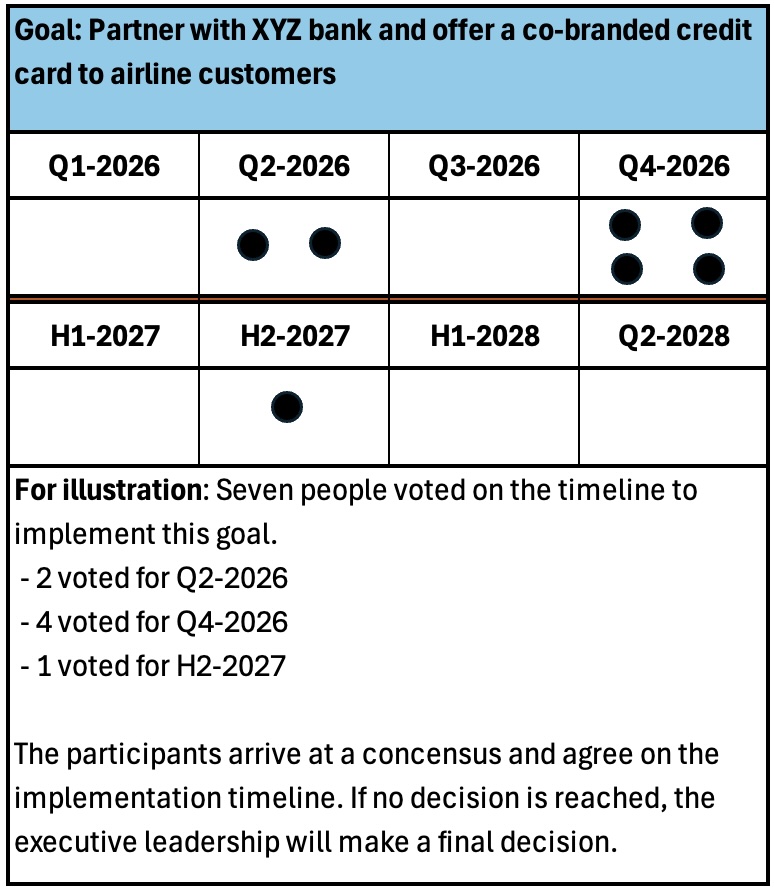
Building a prioritized business roadmap
- The facilitator prepares a business roadmap based on the dot voting outcome.
- The roadmap is shared with every participant for review.
Buy-in from (executive) leadership
- If executive leadership members from the business didn’t participate in the workshops up until now, then they must review the roadmap to gain alignment at this point.
- After gaining alignment, the business roadmap is shared with all the participants, more specifically the technical team.
High-level Technical Feasibility Review – 2 – 3 Days (or longer depending on scope and feasibility assessment)
- IT team reviews the business roadmap.
- IT team determines innovative, cost-effective, yet highly reliable solutions and high-level architectural needs from a feasibility standpoint (no solution is built at this point). If needed, a high-level ballpark estimate with a certain confidence level can be formulated to help prioritize based on ROI.
- IT team determines the technical capabilities or foundation that are needed to commence development.
- The roadmap is updated by incorporating technical priorities and shared with participants for offline review.
Final review with the entire team, including (executive) leadership - ~2-4 hours
- The business and IT teams review the roadmap collectively.
- Questions and/or concerns are addressed and alignment gained.
- A final voice voting is taken to make the roadmap official.
- Determine cadence to review and update the roadmap periodically, as necessary.
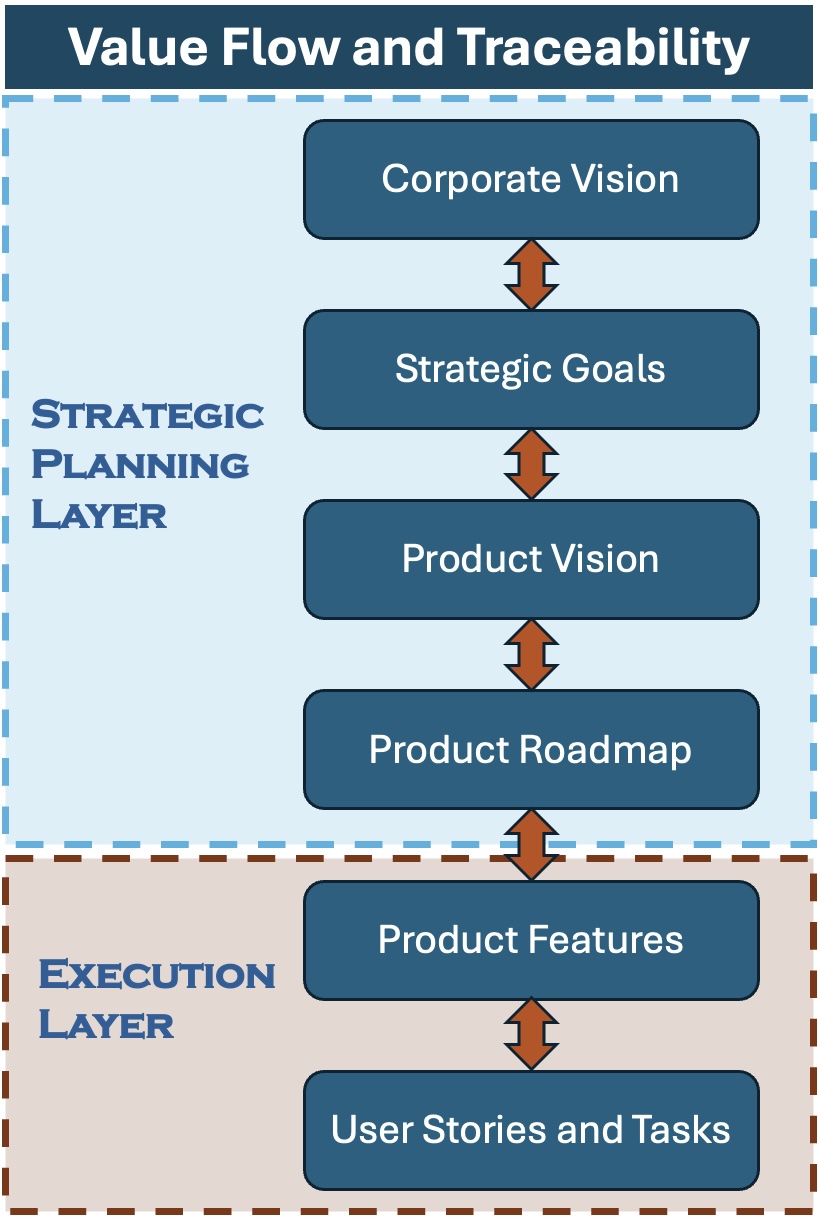
Value flow and traceability
When the roadmap is built using the above framework, the value flow and traceability are outlined to ensure alignment with corporate strategic goals.
Pre-requisites and additional information for effective facilitation:
Pre-requisites:
- The team is available for the workshop without distractions.
- No electronics are used to facilitate, which leads to distraction and/or multitasking that impacts focus.
- Hold a 30-minute meeting, review agenda and gain alignment with every participant to ensure their undistracted participation.
- Selection of participants: Identify a team consisting of business members and IT members (including the architect, tech lead, and IT leadership, if desired). More importantly, individuals who are currently using or will be using the product must be invited. This is vital because direct user feedback provides critical insights into pain points, as they use the product/features day in and day out.
Tips to make it efficient and effective:
- To define the vision, one could even send out a survey to the team asking for ideas.
- When defining a project's vision and mission, tailor their length based on the project's size or budget. Ultimately, the aim is to clearly visualize the problem the product/project solves, why the project exists, and the expected outcome. This clarity gives stakeholders and project team(s) a sense of purpose and motivation by ensuring they understand how the project's outcome will benefit the consumers or customers. It also brings an element of empathy to the work.
- To define product vision and mission, you need a mix of executive leadership, product management, technical and design teams, and end users. This ensures the vision is inspirational yet achievable, and the mission is actionable and aligned with user needs. So, it’s vital to identify a balanced mix of people.
- At times, the executives and managers define the vision, mission, and product roadmap without hearing the pain points and challenges faced by the people who use the products/features every day.
- Word cloud technique could possibly be used to define vision and mission if need be.
- I encourage eliminating electronics and multi-tasking. We should go back to basics, using flipcharts, sticky notes, dry-erase markers, and small stickers for dot-voting. Participants should be encouraged to move around the room and collaborate with each other.
Pitfall to avoid:
#ProductManagement #ProductStrategy #Roadmapping #Agile #ITLeadership #Strategy